Navigating the Road to Agenda 2030: My Observations and Insights, I share what I’ve learned from a deep exploration of global development frameworks, especially the United Nations’ Agenda 2030 and its 17 Sustainable Development Goals (SDGs). What began as a working curiosity evolved into an in-depth look at the actual patterns, policies, and practices these Global Goals have created. This is my analysis of where we are and what lies ahead on this critical journey to achieve the SDGs.
This is a summary of my observations, insights, and interpretations – all based on solo research and actual case tracking. I want to present this without hyperbole or scare, but with earnest thinking about underlying changes I perceive that are occurring around the world.
They are not “controversies” in the melodramatic sense; they are indicators, systemic trends, and implementation patterns that are worth monitoring – particularly for those with an interest in governance, equity, technology, sovereignty, and long-term sustainability.
The Reason Agenda 2030 Exists
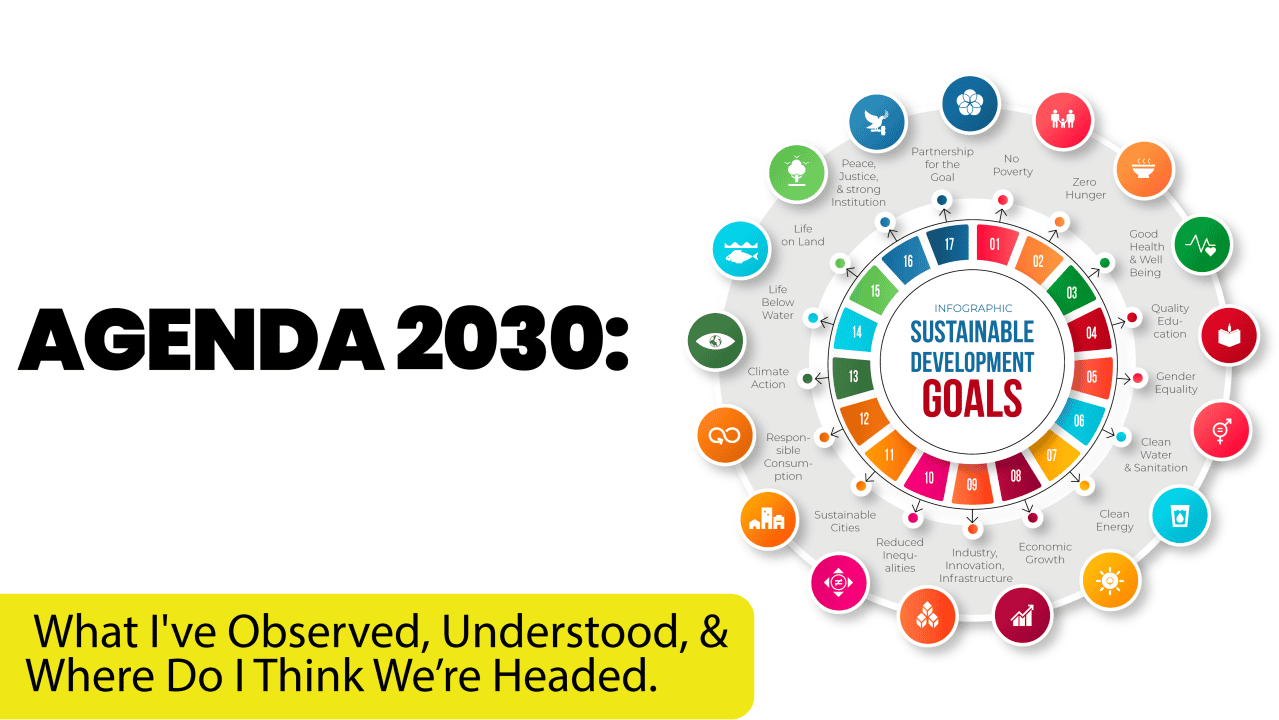
The 2030 Agenda for Sustainable Development was adopted in 2015 by all 193 UN member states. It succeeded the Millennium Development Goals (MDGs), which aimed to establish a more inclusive, universal, and interconnected frameworkfor addressing global poverty, inequality, education, climate change, and beyond.
The Agenda is rooted in a simple conviction: that development should reconcile economic growth, environmental sustainability, and social justice. Its five “P” pillars – People, Planet, Prosperity, Peace, and Partnership – express this integrative vision.
I viewed Agenda 2030 from the beginning as something greater than a moral agenda. It was a soft mode of governance, a common lexicon for coordinating national policies to fit global vision – and above all, a means for indicating direction to public and private institutions across the world.
[ Read More: Process and System Design Services ]
Learning about the Goals: Ambitious, Universal, and Interdependent
The 17 SDGs and 169 related targets range from eradicating poverty (Goal 1) to encouraging partnerships (Goal 17). They intersect every sphere imaginable: food systems, education, health, justice, infrastructure, climate, and so forth.
What has impressed me from the very beginning is how interdependent these goals are. Clean energy cannot be disentangled from poverty. Climate action cannot be disentangled from food systems. Justice (Goal 16) impacts all. It’s a web – not a checklist.
By the same token, I saw that such scale introduces complexity. Governments tend to pick soft-to-report goals and de-prioritize those that require transformative change – such as lowering inequality or transforming models of consumption.
The reality? Agenda 2030 isn’t only about what we aim for, but also about how systems relate to one another.
Patterns I’ve Observed in Implementation
One of the most measurable offshoots of Agenda 2030 is the global expansion of digital identity infrastructure. The Agenda calls for “legal identity for all” by 2030.
In India, the Aadhaar program enrolled more than a billion citizens with biometrics. Analogous systems are being developed in Nigeria, Kenya, and Bangladesh. They are typically framed as inclusion: providing access to welfare, health, banking, and cellular services.
Observation: As much as these systems are extending services to millions, they create new technologies of centralized control and data threat. Poor protections, exclusions, and mission creep (using IDs for purposes other than their original intent) are persistent issues. I’ve seen that the intention might be inclusion, yet implementation needs to be judged on privacy, consent, and equity principles.
2. Smart Cities and 15-Minute Urban Models (Goal 11)
Goal 11 focuses on “inclusive, safe, resilient and sustainable cities.” Since then, I’ve observed a global push toward smart cities: sensor-enabled transport, predictive infrastructure, and AI-led planning.
The more subtle but equally powerful trend is the 15-minute city model – where essential services are accessible within walking distance. Paris, Melbourne, and many other cities are leading this shift.
Observation: Such changes, while well-meaning, have at times precipitated public backlash based on misinformation (e.g., “climate lockdown” conspiracy theories). That says something significant to me: public trust matters. Urban transformations need to be participatory, open, and responsive to real anxieties – even when those anxieties are incorrectly held.
3. Data-Driven Governance and Monitoring Culture
Agenda 2030 brought with it an explosion of indicator frameworks. Governments and multilateral agencies are racing to build dashboards, progress trackers, and AI systems to monitor SDG progress.
Observation: While this data revolution has improved policy visibility, I’ve also observed a subtle behavioral shift – toward managing for metrics. That’s not inherently bad, but in some contexts, it reduces people to numbers and encourages short-term gains over systemic transformation.
The future of SDG tracking needs to be ethically crafted so we don’t lose sight of the people behind the numbers.
4. Synchronizing Policies and Vertical Integration
States are integrating SDGs into national agendas. Ministries are aligning existing programs to targets. Municipalities are generating their own Voluntary Local Reviews. The EU, AU, ASEAN – all regional organizations – have designed their own SDG-compliant strategies.
Observation: This is a positive trend – but it also reflects a kind of global policy synchronization. We’re seeing frameworks, language, and definitions align across borders. Some might celebrate this as global harmony; others may worry about the centralization of policy thinking and the risk of losing local adaptability and sovereignty.
As a systems thinker, I think we should be careful to observe how local nuance is maintained in this more networked model of governance.
Patterns of Note to Repeat
I’ve observed five patterns over the years that I think will influence how Agenda 2030 continues to develop:
1. Techno-solutionism – Increasing belief in technology to address human issues, at times without addressing underlying drivers such as inequality or power relations.
2. Top-down convergence – Converging governance models, instruments, and performance metrics between countries, catalyzed by common benchmarks (e.g., World Bank indicators, SDG tracking indexes).
3. Private sector entrenchment – Partnerships with the private sector are increasing, but so is corporate dominance over public agendas (particularly in energy, health, digital infrastructure).
4. Narrative capture – As it becomes more of a branding game to achieve SDGs, we risk losing essential critique. Not everything branded “sustainable” is necessarily just or equitable.
5. Data over democracy – Digital governance platforms can maximize efficiency but also reduce citizen participation if not integrated with participatory design.
My View of Future Impact
For me, Agenda 2030 will be remembered less for the success or failure of all 17 goals and more for the way it redefined the development discourse across the world.
This is what I think its future impact will consist of:
- It will make global governance language common to “resilience,” “inclusion,” “transparency,” and “sustainability.” That may bring efficiency – but also sameness.
- It will shape how the next generation thinks about justice. Terms such as circular economy, digital public infrastructure, regenerative agriculture, and universal access will be baseline expectations – not ideals.
- It will hasten digital dependency. Through digital IDs, smart contracts, or predictive governance, we’re headed to a future in which access to rights is made possible by technology. This makes tech governance with ethics imperative.
- It will disrupt conventional ideas of sovereignty. As we confront planetary issues, cross-border answers will demand common protocols and collective authority. But that should not compromise community voice and agency.
Navigate, Don’t Abdicate
Agenda 2030 is no conspiracy. Neither is it magic. It’s a template – an open chart.
My recommendation to fellow researchers, founders, policymakers, and citizens: don’t offload your thinking. Learn the objectives of the Agenda. Monitor its roll-out locally. Challenge the narratives – pro and con. And most importantly, make your community voice part of defining what “sustainable development” actually means.
Because when we co-create the future, we don’t simply achieve goals.
We create systems that build trust, safeguard liberties, and serve generations.
If this feels true to your experiences or observations, I’d love to hear your thoughts. Let’s take this discussion further and make sure in our quest for progress, we remain aware, inclusive, and context-sensitive.