A business can have good people, good products, and good technology, but still face problems when its processes and systems are not properly designed.
Work may take too long. Employees may not know who is responsible for a task. Customers may have to wait for approvals. Teams may use different methods to complete the same work. Important information may be stored in different places.
These problems can slow down business growth.
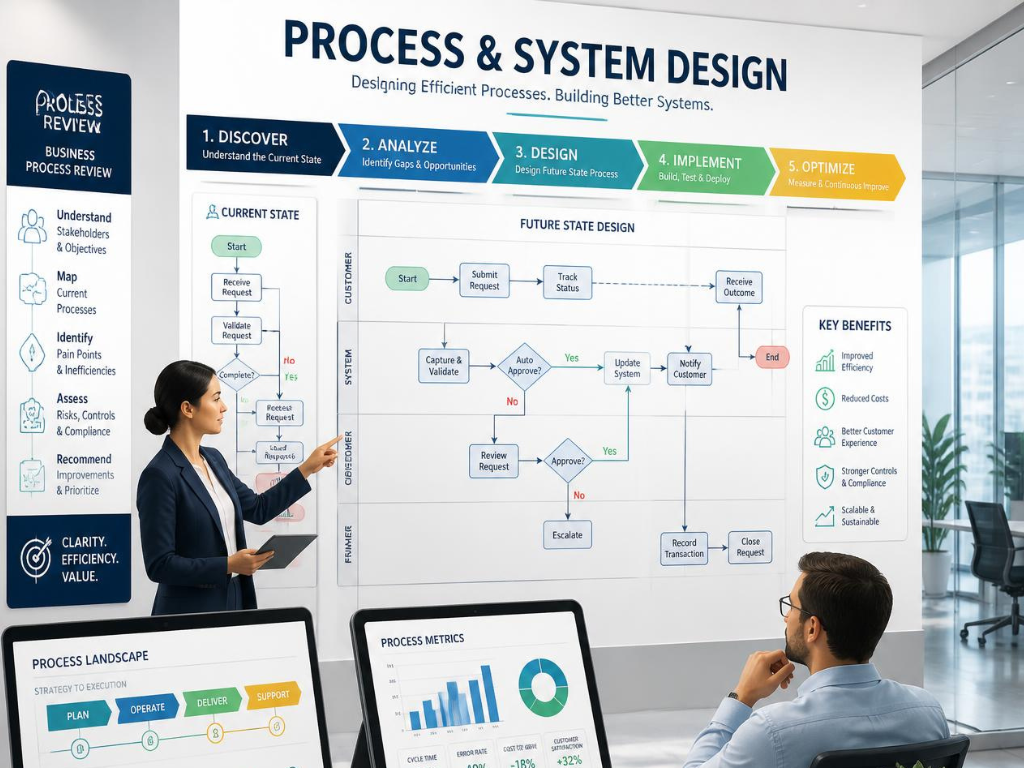
Process and System Design helps businesses understand how work is currently done, identify problems, and create better ways of working.
At The Reform Design (TRD), we review business processes, identify gaps, understand the root causes of problems, and design practical solutions that help businesses work more efficiently.
What Is Process and System Design?
Process and System Design is the process of studying how a business works and creating a better structure for completing its daily activities.
A business process is simply a series of steps followed to complete a particular task.
For example:
Customer Enquiry → Sales Discussion → Proposal → Approval → Payment → Delivery → Customer Support
If one step is slow or unclear, the complete process can be affected.
Process design looks at these steps and asks:
- What is happening now?
- Who is responsible for each step?
- Where are delays happening?
- Are there unnecessary steps?
- Are employees doing the same work more than once?
- Is information moving correctly between teams?
- Can technology make the process easier?
- What should the improved process look like?
Business process improvement commonly focuses on identifying bottlenecks, unnecessary work, errors, and inefficient activities and then making structured changes.
Why Do Businesses Need Process and System Design?
As a business grows, its processes often become more complicated.
A small company may initially manage work through:
- Emails
- WhatsApp messages
- Excel sheets
- Phone calls
- Manual approvals
- Paper documents
This may work when the business is small.
But as the number of employees, customers, projects, and transactions increases, these informal methods can create problems.
Common problems include:
1. Too Many Manual Tasks
Employees may spend hours doing repetitive work that could be simplified or automated.
2. Slow Approvals
A document may move through several people before it gets approved.
3. Poor Communication
Different departments may not have the same information.
4. Repeated Work
Two or more employees may perform similar tasks because responsibilities are not clearly defined.
5. Process Delays
One delayed activity can affect the entire workflow.
6. Lack of Clear Responsibilities
Employees may not know who should complete a task or who should approve it.
7. Inconsistent Work
Different employees may complete the same task in different ways.
8. Difficulty in Tracking Performance
Management may not have clear information about where time, money, or resources are being lost.
A well-designed process can improve consistency, visibility, accountability, and efficiency.
What Is Business Process Review?
A Business Process Review means studying the current way a business works.
Before changing a process, it is important to understand the existing process.
During a business process review, we look at:
- Current workflows
- Employee responsibilities
- Department coordination
- Approval processes
- Customer interactions
- Information flow
- Technology used
- Manual activities
- Delays
- Repeated tasks
- Common errors
- Communication gaps
The goal is not simply to change everything.
The goal is to understand what is working, what is not working, and what can be improved.
What Is Business Process Improvement?
Business Process Improvement (BPI) means making an existing business process better.
The improvement can involve:
- Removing unnecessary steps
- Reducing manual work
- Improving communication
- Clearly defining responsibilities
- Improving approval workflows
- Introducing technology
- Reducing errors
- Improving customer experience
- Reducing delays
- Creating standard procedures
For example, imagine a company takes five days to approve a customer quotation.
After reviewing the process, the company discovers that the quotation passes through four different people even though only two approvals are actually required.
The process can be redesigned:
Old Process:
Sales → Manager → Finance → Director → Approval
Improved Process:
Sales → Manager → Approval
The objective is not simply to make the process shorter. The objective is to create a process that is clear, controlled, practical, and suitable for the business.
What Is System Design?
A business system is more than software.
It can include:
- People
- Processes
- Technology
- Information
- Responsibilities
- Rules
- Workflows
- Reporting
- Decision-making
System Design looks at how these parts work together.
For example, a company may have a CRM system, accounting software, employee management software, and customer support tools.
If these systems do not communicate properly, employees may need to enter the same information multiple times.
A good system design looks at the complete workflow and asks:
How can people, processes, information, and technology work together more effectively?
[Read More: What is a DPR Report? A Complete Guide to DPR (Detailed Project Report) ]
Our Process and System Design Approach
At TRD, our approach follows a structured process.
1. Discover
We first understand the business.
We study:
- Business goals
- Current operations
- Teams
- Customers
- Existing systems
- Current workflows
- Business challenges
The purpose is to understand the business before recommending changes.
2. Define
Next, we identify the main problems.
We look for:
- Process gaps
- Bottlenecks
- Repeated activities
- Communication problems
- Unclear responsibilities
- Manual work
- System limitations
We then define the actual business problem instead of focusing only on the visible symptom.
3. Design
Once the problem is clear, we design a better process or system.
This may include:
- New workflows
- Process maps
- Responsibility structures
- Approval flows
- Information flows
- System requirements
- Improved customer journeys
4. Develop
The recommended solution is developed into a practical business approach.
This can include:
- Process documentation
- Standard operating procedures
- Workflow structures
- System recommendations
- Process guidelines
- Implementation planning
5. Deploy
The improved process or system is introduced into the business.
The objective is to make the solution practical for the people who will actually use it.
TRD’s broader working approach follows Discover, Define, Design, Develop, and Deploy, with the aim of understanding the business problem before developing a solution.
Our Process and System Design Services
Business Process Review
We study your existing business processes to understand how work is currently being completed.
We identify areas where the process can be improved.
Business Process Improvement
We help businesses improve inefficient processes by identifying unnecessary steps, delays, repeated work, and other process problems.
Business Process Design
We create clear and structured workflows for new or existing business activities.
System Review
We review how current business systems support your processes and identify gaps between business needs and existing systems.
System Design and Improvement
We help create better ways for people, processes, information, and technology to work together.
Workflow Design
We map the movement of tasks and information from the beginning of a process to the end.
Process Documentation
We help businesses document important processes so employees have a clear understanding of how work should be completed.
Operational Improvement
We identify opportunities to improve day-to-day business operations and make workflows easier to manage.
Benefits of Process and System Design
A properly designed process can provide several business benefits.
Better Efficiency
Employees can spend less time dealing with unnecessary steps and repeated activities.
Reduced Errors
Clear processes can reduce confusion and improve consistency.
Faster Workflows
Removing unnecessary delays can help work move faster.
Better Employee Productivity
Employees understand what they need to do and who is responsible for each activity.
Improved Customer Experience
A smoother internal process can help businesses respond to customers more consistently.
Better Decision-Making
Clear processes and information flows can give management better visibility.
Reduced Operational Costs
Improving inefficient workflows can reduce wasted time and resources.
Easier Business Growth
Well-documented and structured processes can make it easier to manage increasing business activity.
Process improvement is generally associated with benefits such as improved efficiency, reduced costs, fewer errors, better productivity, and more consistent outcomes.
Process Design vs Process Improvement
These terms are related but they are not exactly the same.
Process Design
Process design focuses on creating a new process or restructuring an existing process.
Example:
A company launches a new customer support department and needs to create a complete workflow.
Process Improvement
Process improvement focuses on making an existing process work better.
Example:
A customer support team already exists, but response times are too slow. The existing workflow is reviewed and improved.
In simple words:
Process Design = Create or redesign the process
Process Improvement = Make the existing process better
Process Management = Monitor and continuously improve the process
This distinction is also reflected in common process-management guidance: design creates the process, improvement makes it better, and ongoing management keeps it aligned with business needs.
Who Needs Process and System Design Services?
Process and system design can be useful for different types of businesses.
Startups
Startups can create structured processes early instead of building operations around temporary workarounds.
Growing Businesses
Growing companies often need to update their processes as employees, customers, and departments increase.
Established Companies
Established organizations may need process reviews to identify outdated or inefficient workflows.
Manufacturing Businesses
Manufacturing companies can review production, procurement, inventory, quality, and supply chain processes.
Service Businesses
Service companies can improve customer enquiry, sales, delivery, billing, and support processes.
Professional Services
Consulting, legal, financial, design, healthcare, and other professional businesses can benefit from clearly defined workflows and responsibilities.
When Should You Review Your Business Processes?
You may need a process review when:
- Your business is growing quickly.
- Employees are overloaded with manual work.
- Customers are experiencing delays.
- Different teams follow different processes.
- You frequently find errors.
- Approvals take too long.
- Employees are unclear about responsibilities.
- You use multiple systems that do not work together.
- Management has limited visibility into operations.
- You are introducing new software.
- You are launching a new service.
- Your existing process no longer supports business growth.
A process review can help identify the actual cause of these problems before changes are made.
How TRD Helps Businesses Improve Processes and Systems
At The Reform Design, process and system design starts with understanding the business problem.
We do not look at a process as an isolated activity.
We consider the relationship between:
Business Goals + People + Processes + Systems + Customers
This helps create solutions that are connected to the wider business.
Our approach focuses on:
- Understanding the current process
- Finding the root cause of problems
- Identifying improvement opportunities
- Designing practical workflows
- Improving system usage
- Defining responsibilities
- Documenting processes
- Supporting implementation
The objective is to create processes that are easier to understand, easier to manage, and better aligned with business requirements.
Why Choose TRD for Process and System Design?
Business-Focused Approach
We start by understanding your business and its goals.
Practical Solutions
The objective is to create solutions that can actually be used by your team.
Problem-Focused Thinking
We look beyond visible problems to understand the underlying causes.
Cross-Functional Understanding
We consider how different departments and activities connect with each other.
Structured Method
Our Discover, Define, Design, Develop, and Deploy approach provides a structured way to move from problem identification to implementation.
Designed for Long-Term Improvement
The goal is not only to solve today’s problem but to create processes that can support future business needs.
Frequently Asked Questions
What is Process and System Design?
Process and System Design is the practice of studying how a business works and creating better processes, workflows, and systems to improve efficiency and business performance.
What is a Business Process Review?
A Business Process Review examines the current way work is completed to identify delays, gaps, repeated activities, errors, and opportunities for improvement.
What is Business Process Improvement?
Business Process Improvement is the structured process of analyzing and improving existing workflows to make them more efficient, consistent, and effective.
Why is process design important?
Process design helps businesses create clear workflows, responsibilities, and ways of working. It can reduce confusion, delays, repeated work, and errors.
Can process design reduce business costs?
It can. Better-designed processes may reduce unnecessary work, manual activities, delays, and resource usage. The actual savings depend on the process and the changes implemented.
Does process design include technology?
It can. Technology may be part of the solution when it helps improve workflow, information management, automation, reporting, or communication.
What is the difference between process design and system design?
Process design focuses mainly on how work is performed. System design looks at how people, processes, information, and technology work together.
How does TRD approach process improvement?
TRD follows a structured Discover, Define, Design, Develop, and Deploy approach to understand the business problem, design a solution, develop the approach, and deploy it.
Can TRD review our existing business process?
Yes. A business process review can be used to understand your current workflow, identify gaps and bottlenecks, and find opportunities for improvement.
Is Process and System Design useful for growing businesses?
Yes. As businesses grow, existing processes may become difficult to manage. Reviewing and redesigning workflows can help create more structured operations.
Build Better Business Processes With TRD
Your business processes should help your team work better—not make work more complicated.
If your business is experiencing delays, repeated work, unclear responsibilities, manual tasks, or system-related problems, a Process and System Design review can help you understand what is happening and identify practical ways to improve it.
The Reform Design helps businesses review, design, and improve processes and systems with a structured, business-focused approach.
Want to improve the way your business works?
Contact The Reform Design to discuss your business process and system requirements.