Most founders read their own Detailed Project Report the way they wrote it — forward, from the idea to the ask. Investors read it backward, from the ask to whichever number is meant to justify it. A document built to survive the first reading rarely survives the second, and the second reading is the one that decides whether the meeting continues.
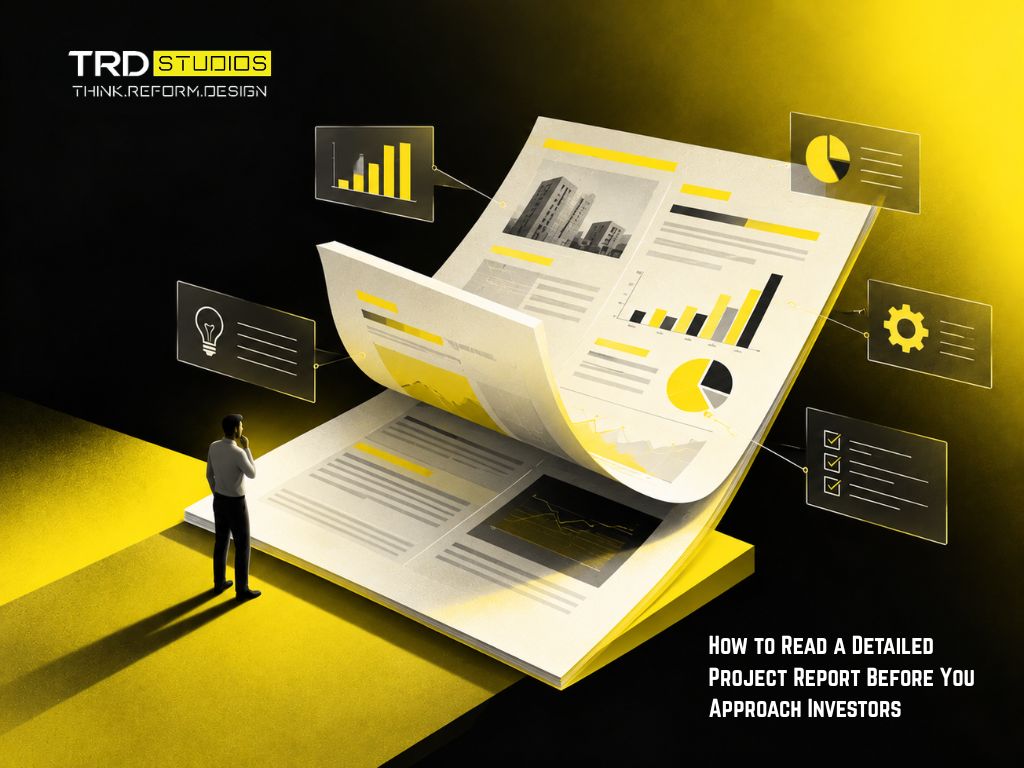
A Detailed Project Report, or DPR, is not the same document as a pitch deck, and treating it as a longer version of one is where most of the damage happens before a founder ever reaches an investor’s inbox. A pitch deck is built to generate interest. A DPR is built to survive diligence once interest exists — it typically contains a feasibility study across market, technical, and financial dimensions, a full set of financial projections, a business model breakdown, risk assessment, and an implementation plan with timelines. The distinction matters because each section is being read for a different failure mode, and a founder who reviews the whole document the same way misses most of them.
Consider how little time the deck itself actually gets. DocSend’s aggregated data on investor behaviour, tracked across 2022 through 2024, puts the average time an investor spends viewing a pitch deck at roughly two minutes and twenty-four to thirty seconds, with a recorded low of two minutes eighteen seconds. That figure describes the deck, not the DPR — but it explains why the DPR exists as a separate document at all. The deck is a filter. Almost nothing in a two-and-a-half-minute skim is being verified; it is being judged for whether it is worth a second look. The DPR is what gets read once that second look happens, and it gets read considerably more slowly, by someone specifically looking for the place where the numbers stop holding together.
[ Read More: Process and System Design Services ]
That is the first thing worth checking before sending a DPR out: whether it was written with the two-minute reader in mind, or the diligence reader. A feasibility study that asserts market size without showing how it was derived, a financial model that jumps from assumption to conclusion without a visible calculation path — these pass a skim easily and fail a close read immediately, because the close reader’s entire job is to find the seam.
The feasibility section deserves particular scrutiny, because it is answering four separate questions that founders frequently collapse into one. Market feasibility asks whether demand exists at the scale claimed. Technical feasibility asks whether the business can actually be built and operated as described, given real constraints. Financial feasibility asks whether the numbers hold up under the business’s actual cost structure, not an idealised one. Operational feasibility asks whether the team and systems required to run this actually exist or can realistically be built in time. A DPR that addresses only market feasibility, dressed up as a full feasibility study, is answering roughly a quarter of the question an investor is actually asking.
Financial projections carry a specific and well-documented failure mode worth naming directly: the planning fallacy, a term introduced by Daniel Kahneman and Amos Tversky in 1979 to describe the tendency to underestimate costs and timelines while overestimating benefits, even among people fully aware that similar projects have historically overrun both. What makes the planning fallacy relevant here is that it persists despite awareness — knowing that most revenue projections run optimistic does not, on its own, make a founder’s own projection less optimistic. The practical implication for reading a DPR before it goes out is specific: the base case is very likely already too favourable, by default, before anyone has reviewed anything. What an investor is actually checking for is not whether the base case looks good — it is designed to — but whether a downside case exists at all, and whether the assumptions behind both cases are stated plainly enough to be challenged individually rather than accepted as a package.
[ Read More: Brand Management Services: Build a Strong, Clear, and Consistent Brand ]
It is worth being precise about terminology here, because the three terms get used almost interchangeably and shouldn’t be. A business plan documents intent and strategy — what the business is trying to do and how. A feasibility study tests whether that intent is actually viable, independent of whether anyone wants it to be. A Detailed Project Report, particularly as the term is used in project finance and institutional lending contexts, typically packages both together with an implementation plan and is built specifically for a reader deciding whether to commit capital. Sending a business plan when a DPR was requested, or a feasibility study when full financial projections were expected, reads to an experienced investor as a founder who has not yet distinguished between documenting an idea and proving one.
A few checks are worth running before a DPR leaves a founder’s hands. Every figure in the financial projections should trace back to a stated assumption, visible in the document, not buried in a spreadsheet the reader does not have. The feasibility study should address all four dimensions, not only the one that happens to be favourable. A downside scenario should exist alongside the base case, with the gap between them explainable in one sentence. And any number that would change materially under a plausible negative assumption — a slower customer acquisition rate, a higher input cost — should be flagged as such rather than presented as fixed.
[Read More: What is a DPR Report? A Complete Guide to DPR (Detailed Project Report) ]
This is, functionally, why an external review of a Detailed Project Report exists as a distinct service rather than a formality attached to writing one. The value is not in producing the document faster. It is in reading it the way an investor will, before an investor does — running the feasibility study against all four dimensions rather than the convenient one, and pressure-testing the financial projections for exactly the optimism the planning fallacy predicts will already be there. At TRD, this adversarial read is a formal stage within how a Detailed Project Report engagement is structured, distinct from and after the drafting itself, for precisely that reason: a document is a poor judge of its own weaknesses, regardless of who wrote it.