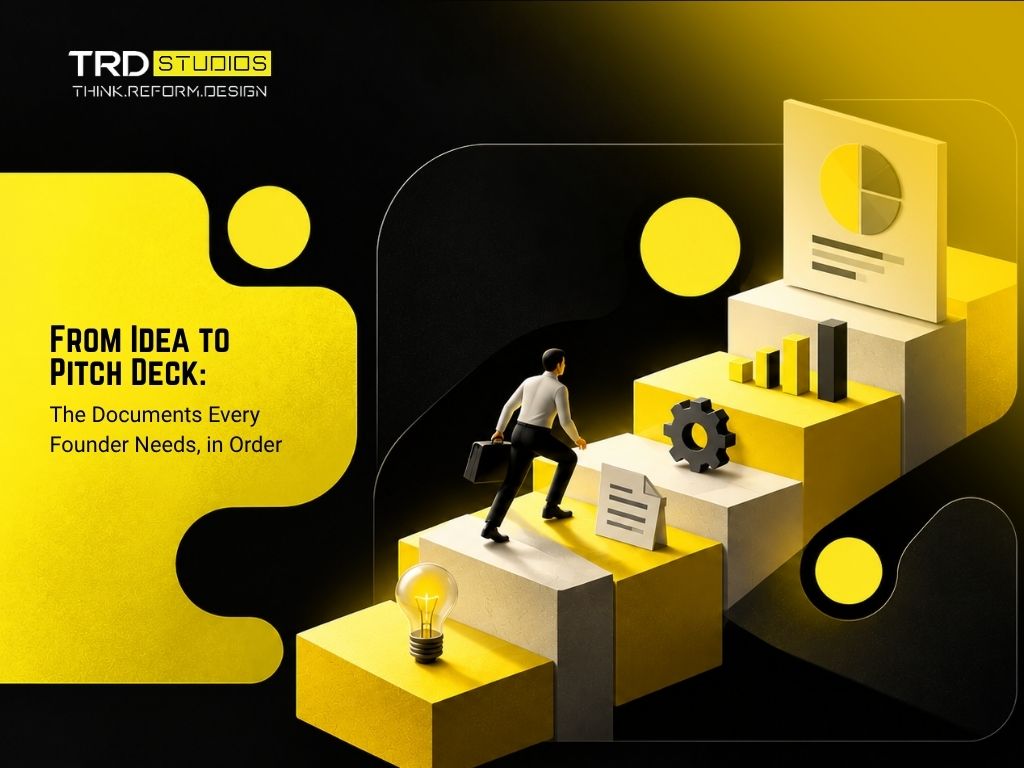
Most founders ask the wrong question first. They ask “do I need a business plan,” when what they actually need to figure out is which document, and in what sequence. A feasibility study, a business plan, a Detailed Project Report, and a pitch deck all sound like variations on the same theme — write down what you’re building and why it’ll work — but they’re built for four different readers, at four different stages, and they don’t substitute for each other. Write the wrong one first and you’ll either waste weeks on detail nobody asked for, or walk into a bank with a document that reads more like a sales pitch than a repayment case.
Here’s the order that actually holds up, and why each document exists.
Start with the feasibility study — because it’s the only one you write for yourself
Before you owe anyone else an explanation, you owe yourself one: is this idea worth pursuing at all? A feasibility study is the cheapest, fastest, least polished of the four documents, and that’s the point. It’s not meant to convince a bank or an investor. It’s meant to stop you from spending six months and your family’s savings on something that a week of honest market and cost analysis would have talked you out of.
A reasonable feasibility study looks at four things without much ceremony: is there a real market at a price people will pay, can you actually source or produce at that price, do you (or your team) have the operational capability to run it, and do the numbers — even rough ones — clear a bar where the business is worth the risk. You’re not building financial models here. You’re pressure-testing the idea before you spend real money finding out the hard way.
[Read More: What is a DPR Report? A Complete Guide to DPR (Detailed Project Report) ]
This is also where a lot of founders skip a step they shouldn’t. It’s tempting to go straight from “I have an idea” to “let me write a business plan,” because a business plan feels like the real, grown-up document. But a business plan built on an idea that hasn’t been feasibility-tested is a plan built on hope. The feasibility study is what earns you the right to plan.
Once the feasibility study says the idea clears the bar, the business plan is where you turn “this could work” into “here’s how we’ll run it”: your positioning, your operating model, your team, your go-to-market approach, your financial projections over the near term. It’s the document that gets your co-founders, early employees, and family stakeholders aligned on what you’re actually building — which matters more than people admit, because misalignment on the fundamentals is a slower and costlier failure than most founders expect.
But there’s a real tension here worth naming. Steve Blank — who has spent decades studying why startups fail — has argued for years that no business plan survives first contact with actual customers. Write it as a static document, treat it as gospel, and you’ll find yourself defending assumptions that reality has already disproved. His alternative isn’t “don’t plan,” it’s “plan differently”: get out and test your assumptions with real customers before you’ve locked in the model, and treat the plan as something you revise as you learn, not something you protect. For an early-stage venture, that’s the more honest posture. Write the business plan, but expect to rewrite sections of it within a few months, because you will have learned things the feasibility study couldn’t tell you.
This distinction matters practically too. A business plan is a strategic document — it’s for you, your team, and anyone you’re bringing into the vision, not for a bank loan officer who needs to know whether you can service debt.
This is where a lot of founders get tripped up, because a Detailed Project Report looks similar to a business plan on the surface — cost estimates, revenue projections, implementation timeline — but it’s built for a completely different reader with a completely different question. A bank doesn’t want to know if your business is inspiring. It wants to know if you can repay the loan.
[ Read More: Brand Management Services: Build a Strong, Clear, and Consistent Brand ]
In India, this isn’t optional once you’re seeking institutional debt: a DPR is mandatory for most bank loans above ₹2 lakh, and under the Mudra scheme, the documentation expectations scale with the loan tier — Shishu loans up to ₹50,000, Kishore from ₹50,000 to ₹5 lakh, Tarun from ₹5 to ₹10 lakh, and Tarun Plus up to ₹20 lakh for those who’ve already repaid a Tarun loan successfully. The DPR has to speak the bank’s language: cost of project, means of finance, projected cash flows, and — critically — your Debt Service Coverage Ratio. Lenders generally want to see a DSCR of at least 1.25 for service businesses and 1.50 for manufacturing; drop below 1.00 and you’re close to an automatic rejection, because that ratio is telling the bank your projected cash flow doesn’t even cover your debt obligations.
So a DPR isn’t a longer business plan. It’s a repayment case, built around numbers a credit officer can underwrite against. If you hand a bank your business plan instead, don’t be surprised when they ask you to redo it in a format they can actually evaluate.
By the time you’re building a pitch deck, you’re usually talking to equity investors, not lenders, and the constraints are entirely different again. Investors aren’t reading for repayment capacity. They’re reading fast, often on a phone, often between other decks. DocSend’s data on pitch deck viewing behavior has consistently shown investors spend somewhere around two and a half minutes on a deck before deciding whether to engage further. That’s not a reader who wants your DPR’s granular cost breakdown. That’s a reader who wants your business’s story and numbers compressed into something they can absorb in the time it takes to get coffee.
This is where Guy Kawasaki’s 10/20/30 rule is a genuinely useful constraint, even if you don’t follow it to the letter: 10 slides, because most people can’t hold more than about ten concepts in a single sitting, and if your business needs more than ten slides to explain, that’s often a sign the model itself isn’t simple enough yet. Twenty minutes, to leave room for the inevitable late start or technical hiccup. Thirty-point font, because it forces you to cut every sentence down to the one thing that actually matters on that slide. None of this is about dumbing the business down — it’s about respecting how little attention you’re actually going to get, and building the deck to survive that constraint instead of fighting it.
The mistake to avoid: writing one document and trying to stretch it four ways
The founders who struggle most with this sequence aren’t the ones who skip a document — they’re the ones who write one comprehensive document and try to repurpose it for every audience. A business plan padded with DPR-style cash flow tables isn’t more convincing to a bank; it’s just harder to underwrite. A pitch deck with feasibility-study-level market analysis isn’t more rigorous; it’s a deck nobody finishes reading. Each document earns its own effort because each reader is evaluating a different question, and conflating them usually means none of the four actually lands.
This is also, in a lot of ways, the case for not doing all four of these alone from scratch each time — not because founders can’t write them, but because getting the sequencing, the audience calibration, and the numbers underwriting-ready right the first time takes more than one pass. It’s a big part of what we help founders work through at TRD: not writing a document for its own sake, but figuring out which one you actually need right now, and building it so the person reading it — whether that’s you, a co-founder, a bank, or an investor — gets what they came for.