
Business frameworks are rarely original in their stages. They are distinguished, almost always, by whether the sequence is actually honoured once real pressure is applied to it.
This is worth stating plainly because the instinct, on encountering a five-stage model, is usually to ask whether the stages are the right ones. That is the less useful question. The more useful one is whether an organisation under deadline pressure will actually complete stage one before jumping to stage three — because the historical record suggests most will not, regardless of how the stages are labelled.
Consider the lineage. Motorola developed Six Sigma in 1986, credited to engineer Bill Smith working with Mikel Harry, structured around a sequence known as DMAIC: Define, Measure, Analyse, Improve, Control. General Electric adopted it as a core part of its operating culture under Jack Welch through the 1990s, by which point roughly two-thirds of Fortune 500 companies had launched Six Sigma initiatives of their own. Separately, and for an entirely different purpose, Stanford’s d.school and the design firm IDEO popularised a five-stage design thinking process: Empathise, Define, Ideate, Prototype, Test. Separately again, quality management inherited the Plan-Do-Check-Act cycle from Walter Shewhart’s work at Bell Labs in the 1930s, later popularised by W. Edwards Deming across postwar Japanese manufacturing.
Three disciplines — statistical process control, product design, and manufacturing quality — arrived independently at a structurally identical rule: no solution work begins before a mandatory diagnostic stage concludes. DMAIC will not permit Improve before Measure and Analyse. Design thinking will not permit Prototype before Empathise and Define. PDCA will not permit Do before Plan. The vocabulary differs. The gate does not.
This convergence is worth taking seriously precisely because it happened independently, across disciplines with little reason to borrow from one another, over roughly a century. When three unrelated fields solve the same organisational problem the same way without coordinating, that is reasonably strong evidence the underlying rule reflects something true about how problem-solving actually degrades under pressure, rather than a shared fashion.
There is a popular illustration of this same idea that is worth examining critically, because the way it circulates says something useful about how business ideas travel. A widely repeated quotation holds that Einstein, given an hour to solve a problem on which his life depended, would spend fifty-five minutes defining the problem and five minutes solving it. Quote Investigator has traced this claim in detail and found no evidence Einstein ever said anything resembling it — the phrase does not appear in the definitive Princeton University Press collection of his verified statements. Its earliest documented form appears in a 1945 leaflet by a University of Michigan education professor, George Carrothers, who attributed a similar sentiment to the mathematician Robert Aley. The Einstein attribution did not appear until 1973, nearly three decades later, after the quote had already passed through at least one earlier misattribution to an unnamed Yale professor. The underlying claim — that problem definition deserves disproportionate time relative to solving — is almost certainly correct, and is independently supported by the DMAIC, design thinking, and PDCA lineages above. Its most famous packaging is simply invented, which is a useful reminder that a claim’s frequency of repetition is not evidence of its sourcing.
[ Read More: Brand Management Services: Build a Strong, Clear, and Consistent Brand ]
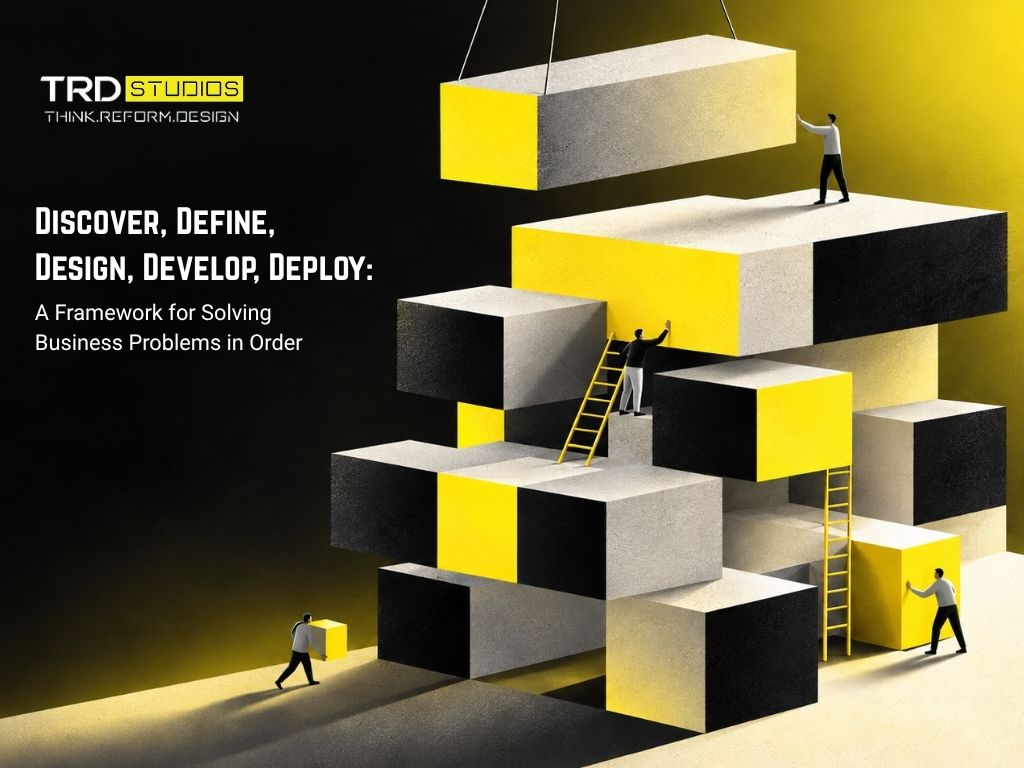
TRD’s five stages — Discover, Define, Design, Develop, Deploy — occupy the same lineage as DMAIC and design thinking, extended to a different unit of analysis. Discover and Define constitute the diagnostic gate, structurally equivalent to Measure and Analyse in Six Sigma, or Empathise and Define in design thinking. Design and Develop constitute the solution-building phase, equivalent to Improve or Prototype. Deploy is closest to Control — the stage concerned with ensuring a solution holds once implemented, rather than degrading immediately after the consultants leave.
What differs is scope. Six Sigma was built to diagnose a manufacturing process. Design thinking was built to diagnose a product or a user experience. Both are deliberately bounded to a single functional domain, which is part of why each has been so successfully adopted at scale — a bounded diagnostic is easier to run consistently than an unbounded one. The 5D model applies the identical sequencing logic to the business as a whole: financial structure, brand, operating systems, and market approach diagnosed together rather than as separate exercises run by separate teams with no obligation to reconcile their findings.
[Read More: What is a DPR Report? A Complete Guide to DPR (Detailed Project Report) ]
This wider scope raises the cost of skipping the diagnostic gate rather than lowering it. A manufacturing team that compresses Measure and Analyse under deadline pressure produces a flawed process improvement, contained to one production line. An organisation that compresses Discover and Define before a rebrand, a systems overhaul, or a market launch produces a flawed decision that then propagates across brand, marketing, and operations simultaneously, each compounding the others’ errors rather than containing them.
The pressure to compress the diagnostic stage is not a hypothetical risk. It is close to the default outcome, for a reason every one of the frameworks above shares: diagnostic work produces no visible artifact for a period of time, while stakeholders — internal or client-side — generally want early evidence of progress. A logo, a prototype, a slide of recommendations: these are visible and reassuring. A well-run Discover phase produces neither, for weeks, and the pressure to shorten it in favour of something demonstrable is constant and, from the sponsor’s perspective, entirely reasonable.
Resisting that pressure is less a matter of process design than of institutional discipline, and it is the primary reason the sequence has to be enforced rather than merely documented. At TRD, Discover and Define are treated as non-negotiable regardless of a client’s understandable desire to see something built. The historical pattern across Six Sigma, design thinking, and PDCA suggests this is not a stylistic preference. It is the specific stage every durable problem-solving methodology of the last century has refused to compress, because every one of them was built by people who had already watched what happens when it is.