Business lifecycle management is a phrase used with some frequency and defined with very little precision. It is worth establishing what it actually denotes before addressing why so few organisations practise it.
The term borrows its logic from an older, better-documented discipline: product lifecycle management. PLM emerged as a formal engineering practice in the 1980s, with its first well-documented implementation at American Motors Corporation in 1985, where CAD tools and a centralized documentation repository were used to accelerate development of the Jeep Grand Cherokee. The innovation was not the technology itself but the underlying premise — that a product’s concept, design, manufacture, and eventual obsolescence should be managed as a single continuous process, owned by one coordinating function, rather than as a sequence of handoffs between departments that rarely spoke to one another. The approach proved sufficiently effective that when Chrysler acquired American Motors in 1987, it retained the system, and the resulting efficiencies are widely credited with helping Chrysler become the lowest-cost American manufacturer within the following decade.
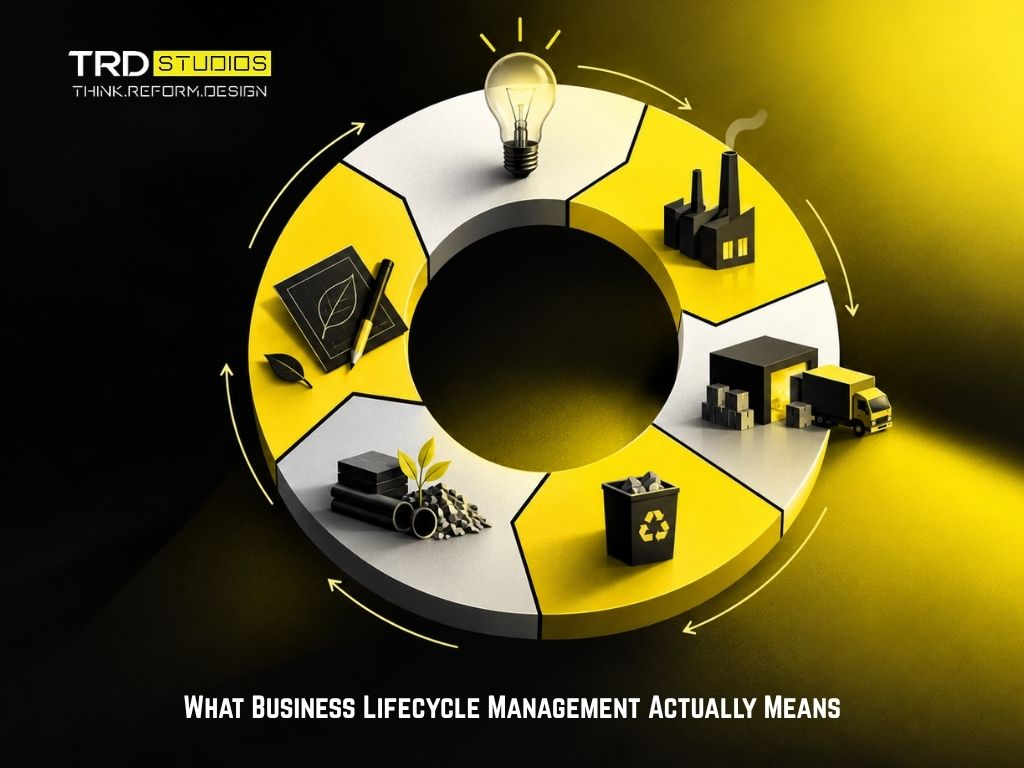
Business lifecycle management applies the same premise to the enterprise itself. An organisation moves through reasonably distinct phases — an untested idea, a built product or service, a market launch, and a subsequent growth period with its own distinct demands. The claim underlying business lifecycle management is straightforward: these phases benefit from continuity of ownership, in the same way a vehicle programme benefits from a single coordinating record rather than four disconnected ones. Most organisations do not manage them this way. Each phase instead triggers a new procurement decision, a new vendor relationship, and a new period during which that vendor must reconstruct, from nothing, an understanding of the business the previous vendor already possessed.
The failure is rarely visible within a single phase. It is visible at the transitions between them. A business that has just finished building a product and is preparing to launch it typically issues a fresh brief to a marketing partner who has no prior relationship with the business, and who must therefore spend the early part of the engagement re-establishing facts — positioning, unit economics, customer definition — that were already established, at cost, during the build phase. That knowledge does not transfer with the business. It generally departs with whichever advisor last held it.
Three structural reasons explain why this keeps happening, and none of them concern individual judgment.
[Read More: What is a DPR Report? A Complete Guide to DPR (Detailed Project Report) ]
The first is financial planning architecture. Corporate budgets are constructed annually and allocated by department, not by lifecycle stage. A launch-stage marketing spend and a growth-stage systems investment are approved through entirely different budget lines, frequently by different people, in different fiscal cycles. An organisational structure built this way has no natural mechanism for commissioning a single relationship that spans stages, regardless of whether anyone believes, in principle, that it would be preferable.
The second is executive tenure, and the data here is unambiguous. Average CMO tenure at S&P 500 companies stood at 4.1 years as of 2026, according to Spencer Stuart’s tracking of the role — the shortest average tenure of any position in the core C-suite. A launch-stage initiative commissioned by a CMO with roughly four years in seat has a limited window in which to demonstrate a bounded, attributable result before that sponsor moves on. Multi-year, lifecycle-length commitments whose full value only becomes visible well beyond a single tenure are structurally disadvantaged against narrower initiatives whose payoff can be claimed before the sponsor leaves. This is not a failure of ambition. It is a rational response to an incentive structure that rewards visible, bounded wins over slower, compounding ones.
The third is procurement mechanics, and it echoes a principle familiar from software engineering: organisations tend to produce arrangements that mirror their own internal communication structure. A procurement process built around a single departmental budget and a single scoped deliverable will reliably produce single-department, single-stage vendor relationships, even when the organisation’s stated intent is continuity. The purchasing mechanism itself was never built to commission anything else.
The cost of this is not primarily financial, though the financial cost is real — every re-engaged vendor rebuilds, and rebills for, discovery work a continuous partner would already possess. The larger cost is compounding drift. Positioning decided at the build stage quietly diverges from messaging decided at launch, which diverges again from the systems built to support growth, because no single party held all three decisions simultaneously and had reason to reconcile them. Each individual decision was reasonable given what its maker knew. None of them knew what the others knew.
[ Read More: Process and System Design Services ]
This is the specific mechanism TRD’s operating model relies on. The 5D process — Discover, Define, Design, Develop, Deploy — is not a framework applied once, at an engagement’s outset, and then retired. It is applied in full to whatever specific challenge a given phase presents: a feasibility question at ideation, a systems or product question at the build stage, a go-to-market question at launch, a scaling question at growth. Each phase constitutes its own complete cycle of diagnosis and execution, rather than a single company-wide diagnosis performed once and assumed to remain valid indefinitely.
What changes between phases is the challenge the cycle is applied to. What does not change is the party running it, or what that party already knows about the business from the cycle before it. A growth-stage Discover phase, for instance, begins from findings the launch-stage Deploy phase already established, rather than from an empty file. The diagnostic work still happens at every transition — nothing is skipped — but it compounds on what preceded it instead of reconstructing it from nothing.
[ Read More: Brand Management Services: Build a Strong, Clear, and Consistent Brand ]
The distinction is not that TRD’s clients receive less diagnostic work. It is that the same five-stage process, run repeatedly and by the same party, accumulates knowledge across phases rather than discarding it at each handoff.